



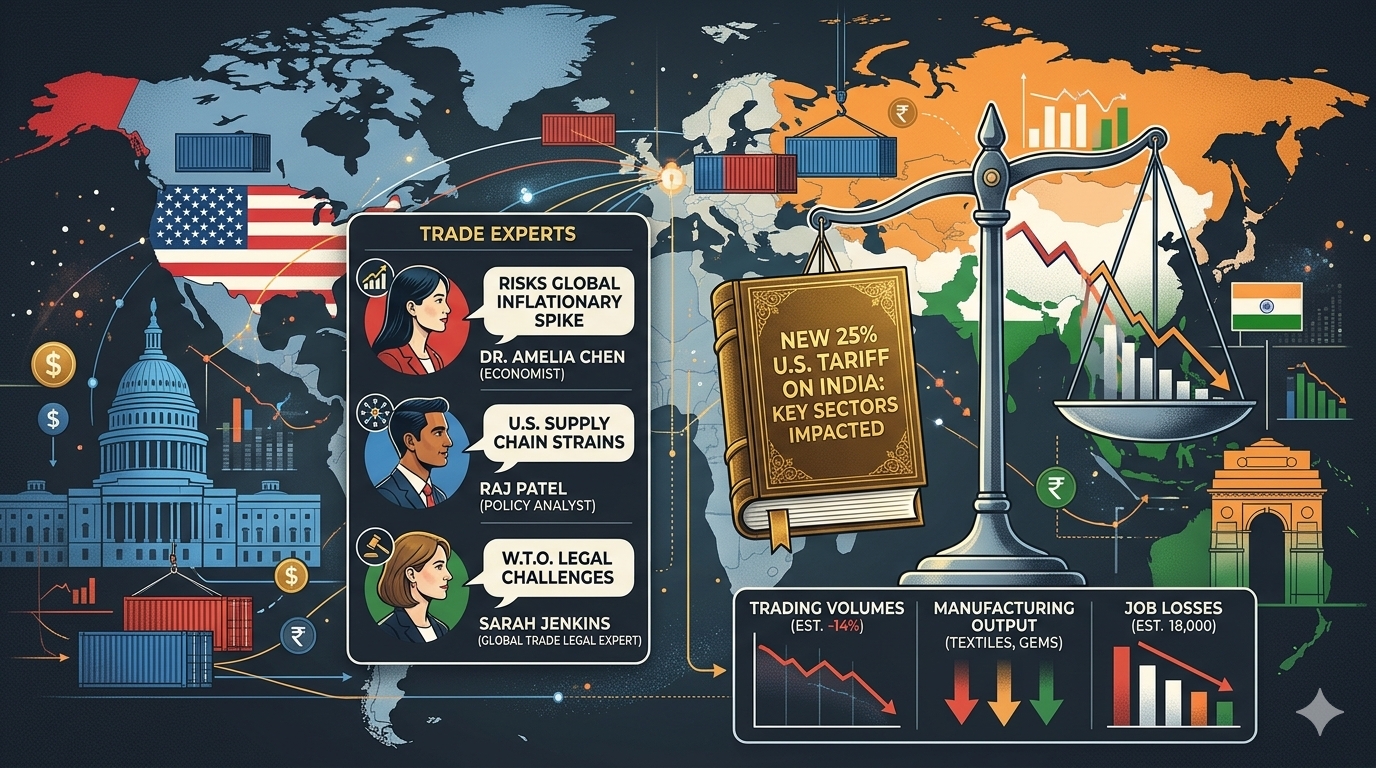
Washington’s latest trade of move of imposing “new US tariff on India” has sparked intense debate across New Delhi’s policy circles and export hubs. Following an eight-month Section 301 investigation into alleged structural excess manufacturing capacity, the Office of the United States Trade Representative (USTR) proposed fresh tariffs of up to 25% on Indian imports. At the same time, American officials offered to cap that duty at 17% if India signs a reciprocal bilateral trade agreement addressing Washington’s concerns. As exporters digest the announcement, trade economists and industry leaders are divided on whether the new US tariff on India represents a strategic opening or a high-stakes trap.
Think Tanks Warn Against Accepting “Calculated Bait”
Leading trade analysts have urged the Indian government not to rush into lopsided concessions just to secure the lower 17% rate. Ajay Srivastava, founder of the Global Trade Research Initiative (GTRI), described Washington’s 17% offer as “calculated bait” designed to extract unilateral market access from trading partners.
Srivastava pointed out that the USTR report specifically targets flagship domestic manufacturing programs, including Make in India, the Production Linked Incentive (PLI) scheme, and Atmanirbhar Bharat. According to GTRI’s analysis, Washington is effectively penalizing India for building domestic industrial capacity while using steep tariffs to shield its own producers. Rather than signing a restrictive pact, GTRI recommends that New Delhi challenge the USTR’s findings sector by sector ahead of the January 2027 public hearings, demonstrating that Indian factory expansion serves legitimate domestic consumption and global demand rather than predatory dumping.
Industry Bodies See Both Risk and Relative Advantage
While policy think tanks counsel caution, domestic export organizations are focused on immediate order books and price competitiveness. Speaking on the proposal, PHD Chamber of Commerce and Industry (PHDCCI) Secretary General Ranjeet Mehta characterized the new US tariff on India as both a challenge and an opportunity. Mehta noted that concluding the bilateral trade agreement swiftly could place Indian suppliers in a relatively favorable position compared with several rival manufacturing nations.
Engineering Export Promotion Council (EEPC India) Chairman Pankaj Chadha emphasized that exporters care far less about absolute duty figures than the tariff gap between India and its direct competitors. Meanwhile, Federation of Indian Export Organisations (FIEO) Director General Ajay Sahai warned that failing to lock in a deal would expose businesses to a 25% tariff—creating roughly an 8 percentage point cost disadvantage over the 17% benchmark and stalling purchasing decisions among American buyers until regulatory clarity emerges.
How India Stacks Up Against Asian Rivals
Economists examining the fine print note that the proposed tariff matrix creates a mixed competitive picture across Asia:
- Narrow edge over major manufacturing peers: Under a completed trade deal, India’s 17% duty would sit 1 percentage point below the 18% rate proposed for Bangladesh, Cambodia, Indonesia, Malaysia, and Thailand, and 3 percentage points below the 20% rate set for Vietnam and China.
- Vulnerability to uncovered economies: Because the USTR’s excess-capacity probe covers 16 major economies, analysts warn that exporters in countries left outside this specific action—such as Sri Lanka, the Philippines, and Turkiye—could enjoy a relative tariff advantage in American retail aisles.
- Uneven sectoral exposure: India’s two largest export categories to the United States—generic pharmaceuticals and smartphones—alongside Section 232 metals and auto components are spared from the new hike. However, labor-intensive and emerging sectors including textiles, gems and jewelry, frozen shrimp, solar modules, and medical devices remain directly exposed.
Analysts Push for a Long-Term “US+1” Trade Strategy
Beyond the immediate January 5 comment deadline and January 25 USTR hearings in Washington, geopolitical economists argue that Indian businesses must prepare for a permanently protectionist American market. Trade researchers at the Institute of South Asian Studies at the National University of Singapore warn against assuming that tariff pressures will vanish after future US elections, noting that skepticism toward trade deficits and industrial subsidies now enjoys bipartisan backing in Washington.
Experts increasingly advise New Delhi and Indian exporters to pursue a disciplined “US+1” diversification strategy. By actively utilizing existing and upcoming free trade agreements across Europe, the Middle East, and Asia, Indian manufacturers can reduce their reliance on a single destination. For now, how New Delhi balances firm diplomatic pushback against pragmatic deal-making over the coming weeks will determine whether the new US tariff on India turns into a costly margin squeeze or a rare competitive opening.

Swarnava Chakraborty writes about esports, gaming and business news for The Pop Sports, covering competitive tournaments, game culture and market updates.