



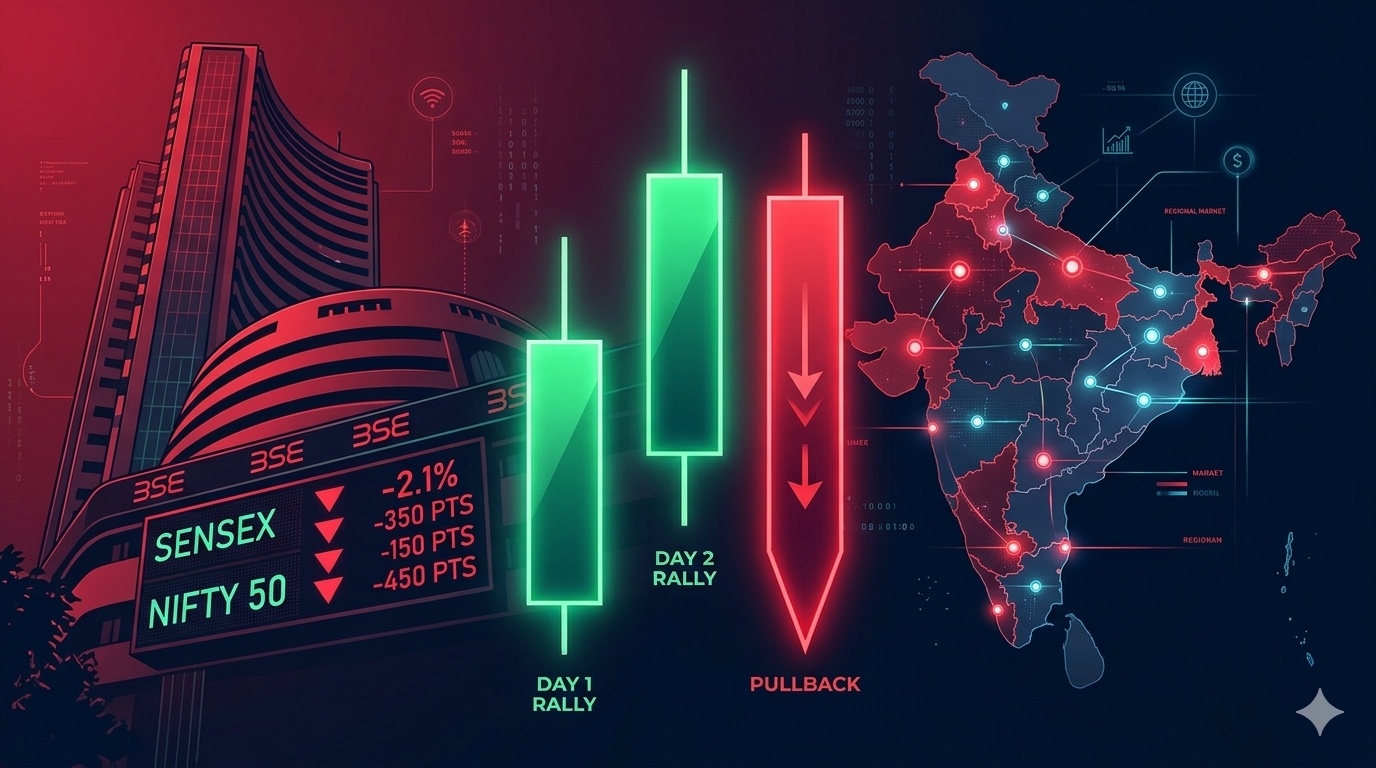
Domestic equity benchmarks turned lower on Dalal Street as traders booked gains following back to back sessions of upward momentum. An Indian market decline after two days rally is a familiar pattern whenever frontline indices approach key technical resistance zones without a fresh domestic catalyst. After two consecutive days of broad buying across heavyweight counters, market participants turned cautious, locking in short term profits and reassessing global risk appetite. While selective accumulation continued in defensive pockets, selling pressure in index heavyweights pulled both the Sensex and Nifty into the red, reminding traders how quickly sentiment can shift near elevated levels.
Profit Booking Takes Center Stage at Higher Levels
Rapid two day advances often leave short term technical indicators stretched, prompting active traders to take money off the table. When benchmark indices climb sharply over forty eight hours, institutional desks and retail momentum players alike look to protect accumulated gains before the weekend or major economic data releases.
Broader market segments frequently feel this pullback even more than large cap stocks. Midcap and smallcap counters, which tend to outperform during brisk relief rallies, usually witness faster profit taking once buying momentum slows. Rather than signaling panic, this cooling phase reflects routine supply emerging at higher price bands where earlier buyers had been waiting to exit.
Global Cues and Foreign Institutional Flows Weigh on Sentiment
Indian equities remain closely linked to global liquidity trends and overnight cues from major international exchanges. Subdued sessions across Wall Street and key Asian markets often encourage domestic traders to trim leveraged positions after a two day bounce. Movements in US Treasury yields and shifting expectations around global interest rate trajectories also influence how aggressively foreign funds deploy capital across emerging markets.
Foreign Institutional Investors frequently use brief rallies as windows to pare exposure, especially when global bond yields stay firm or the US dollar strengthens. Domestic Institutional Investors and steady retail mutual fund inflows continue to provide a structural cushion on declines, yet persistent foreign selling at higher levels can still tip the intraday balance downward.
Sectoral Pressure and Macro Headwinds Behind the Dip
Beneath the headline index numbers, an Indian market decline after two days rally usually traces back to targeted selling across a few heavyweight sectors and macro variables:
- Banking and financial stocks: Private and public sector lenders carry the largest weight in benchmark indices, meaning even modest profit booking in top banks quickly drags the Nifty lower.
- Information technology: Export focused IT majors react swiftly to cautious commentary around global enterprise tech spending and fluctuations in US economic data.
- Currency and crude oil sensitivity: Any weakness in the Indian rupee against the US dollar or an uptick in Brent crude oil prices revives concerns over imported inflation and corporate input costs.
- Metals and cyclical counters: Commodity linked stocks often see sharp swings after short rebounds as traders track global demand signals and currency movements.
How Investors Read an Indian Market Decline After Two Days Rally
Market analysts rarely judge the health of an uptrend by a single red session following two strong days. Instead, desk strategists examine market breadth, intraday trading volumes, and movements in the India VIX volatility gauge to see whether selling pressure is broad or confined to routine index rebalancing. When declining stocks outnumber advancing ones only marginally, institutional desks often treat the move as pause rather than distribution. If the Nifty holds above its immediate support zones, technicians generally view the dip as healthy consolidation rather than a structural breakdown.
For long term investors, periodic pullbacks after brief rallies are a standard feature of equity investing rather than a reason to alter core allocations. Focusing on earnings visibility, balance sheet strength, and disciplined staggered buying helps market participants look past daily index noise and stay aligned with India’s broader economic trajectory.

Swarnava Chakraborty writes about esports, gaming and business news for The Pop Sports, covering competitive tournaments, game culture and market updates.