



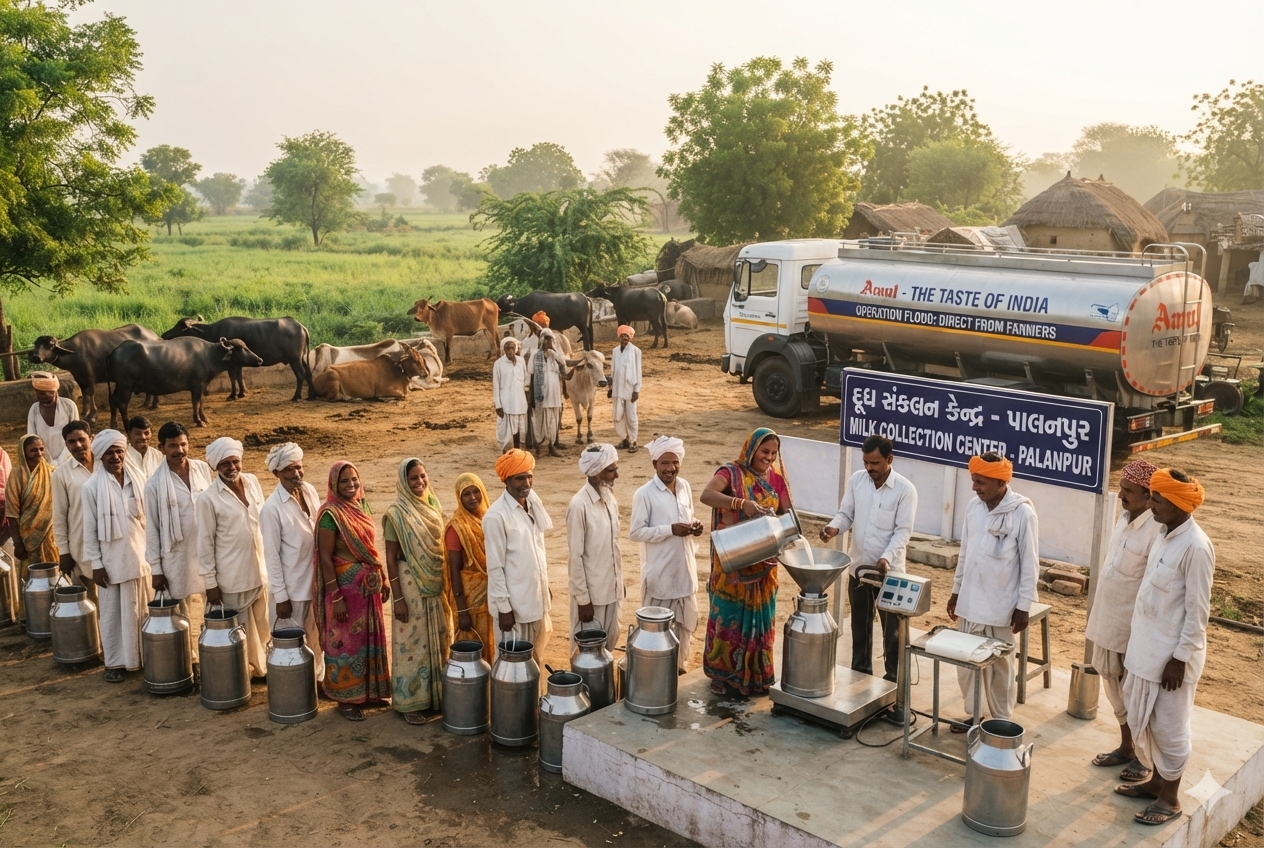
There was a time when the country did not even have enough milk for its own people; it had to rely on donations of powdered milk from abroad. Today, however, the picture is entirely different. India has ascended to the top position globally in milk production, with nearly one-fourth of the world’s total milk supply now coming from our country. This success did not happen overnight. It was the result of the hard work of millions of dairy farmers, the establishment of cooperative societies, strategic government initiatives, and the visionary leadership of Dr. Verghese Kurien—all of which paved the way for India’s ‘White Revolution.’ How did a nation once plagued by a severe milk shortage become the world’s leading producer? And what role did Amul and ‘Operation Flood’ play in this journey?
Milk and dairy products hold a special place in our daily diet—from the tea we drink in the morning to the curd (yogurt) we consume with our meals. Milk is also indispensable for making paneer, ghee, butter, and various sweets. In the past, however, domestic milk production was far lower. The situation has since transformed completely. In 1998, India surpassed the United States to become the world’s largest milk producer. The architect behind this monumental shift was Dr. Verghese Kurien, widely regarded as the father of India’s White Revolution. His birthday, November 26, is celebrated across the country as National Milk Day.
‘The White Revolution’
The foundation for India’s ‘White Revolution’ was laid in the small town of Anand, Gujarat. The core strength of the ‘Amul’ brand lies in its cooperative system for farmers. At that time, dairy farmers were not receiving fair prices for their produce; the dominance of middlemen meant that very little of the earnings actually reached the farmers’ pockets. To change this, the farmers joined forces to form cooperative societies. They took charge of collecting, processing, and marketing the milk themselves, which allowed them to connect directly with the market and significantly increase their profits.
In January 1970, ‘Operation Flood’ was launched under the aegis of the National Dairy Development Board (NDDB), with Dr. Verghese Kurien at the helm. Interestingly, India’s journey toward self-sufficiency in milk production began with foreign aid. The European Economic Community (EEC), through the World Food Programme (WFP), provided India with skimmed milk powder and butter oil.
Operation Flood
Even five decades after the launch of ‘Operation Flood,’ the momentum of progress in India’s dairy sector continues today. In some rural areas, farmers still lack access to milk cooperatives; the goal is to establish milk procurement systems in these regions as well, thereby integrating farmers into an organized market. To this end, ‘White Revolution 2.0’ was launched in December 2024. Meanwhile, the demand for Indian dairy products is growing in the international market, with exports reaching countries such as the United Arab Emirates, Saudi Arabia, the United States, and Bhutan. Once reliant on foreign aid to bridge its milk deficit, India has now ascended to the top spot globally in milk production.
The funds generated from the sale of these donated commodities were invested in the development of the dairy industry. Milk collection centers were established across villages, alongside the installation of chilling plants and processing units. This provided rural farmers with a consistent, daily market for their milk. The ‘Operation Flood’ program continued until 1996, driving significant improvements in milk production, procurement, and distribution systems nationwide. Consequently, just two years later, in 1998, India emerged as the world’s largest milk producer.
Alongside Dr. Verghese Kurien, Harichand Megha Dalaya played a pivotal role in the success of Amul. They pioneered a method to produce skimmed milk powder from buffalo milk—a significant innovation, as large companies previously relied exclusively on cow’s milk. Amul gained a significant market advantage by producing powdered milk from buffalo milk.
Currently, the network of dairy cooperatives in the country spans approximately 245,000 villages. Uttar Pradesh and Rajasthan lead the nation in milk production, followed by Madhya Pradesh, Gujarat, and Maharashtra. More than half of the country’s total milk production comes from these five states. In the 2024-25 financial year, India produced approximately 248 million tonnes of milk—an increase of nearly 70 percent compared to a decade ago. These figures serve as evidence of the rapid growth in the country’s milk production.
The Crucial Role of Women in India’s White Revolution
The contribution of rural women to the success of India’s dairy sector is undeniable. Women make up about 70 percent of the workforce in the country’s dairy industry. They are no longer confined to tasks within the cattle shed; they are now actively involved in making major business decisions. Of the 25 milk-producing organizations established with the support of NDDB Dairy Services, 18 are entirely managed by women, with female representatives also serving on their boards.

Raju Srivastav covers cricket, football and business news for The Pop Sports, from match reports and tournament updates to stock market and economy stories.