



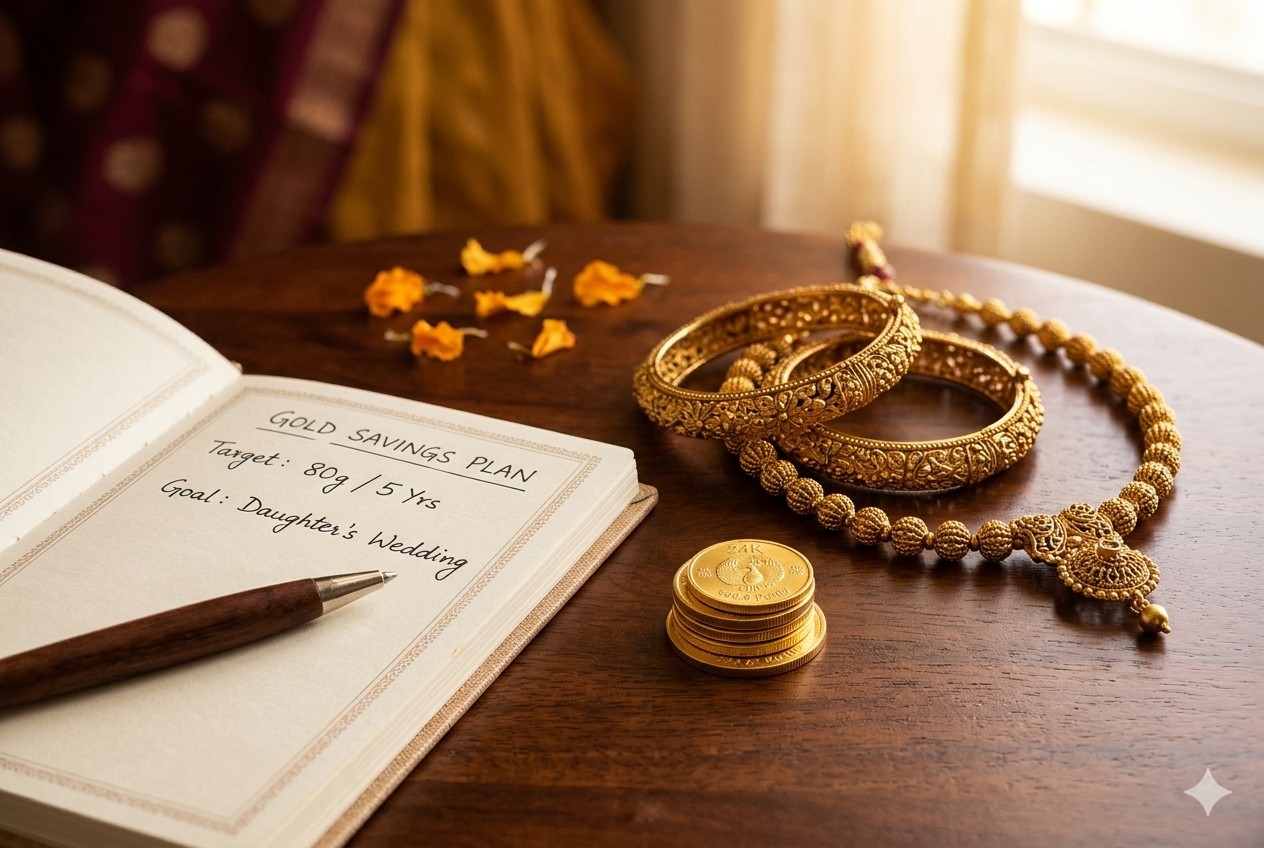
Gold Investment: In Indian households, gold is more than just jewelry—it is a form of security for the future. Parents, especially those with daughters, often dream of accumulating gold for their future weddings. However, many are unaware of the most profitable way to purchase it. Some assume that since gold prices are constantly rising, any purchase will inevitably be profitable—but this is a major misconception. Depending on how you buy gold, you could either save—or lose—thousands of rupees in GST, wastage charges (VA), and making charges. For instance, suppose you want to acquire 80 grams (8 tolas) of 22-carat gold jewelry for your daughter’s wedding five years from now. Let’s explore the best methods to accumulate gold.
- Gold Coins and Bars
Many people invest their savings by purchasing gold coins and storing them in a locker. The advantage is that the gold remains physically in your possession, free from the complexities of digital or technical accounts. However, there are significant drawbacks: you must pay 3% GST at the time of purchase, in addition to making charges. Furthermore, if you decide to use these coins to craft jewelry five years later, a jeweler will value them as “old gold” (at a lower rate). You would then have to pay additional wastage charges, making charges, and GST on the new jewelry—effectively resulting in a loss twice over!
- Digital Gold
Platforms like PhonePe or Google Pay allow you to purchase digital gold for as little as one rupee. While this offers the convenience of investing small, spare amounts of money, it comes with several disadvantages. There is a significant “spread” (the difference between the buying and selling price), and a 3% GST is applied. Most importantly, digital gold lacks the protection of a regulatory body like SEBI. In November 2025, SEBI issued a warning to the public regarding this. Consequently, it is not a secure option for large-scale or long-term investments.
- Gold ETF
Gold ETFs allow you to purchase gold in the form of units, much like buying shares in the stock market. You need a Demat account for this. The advantages include the absence of any risk of theft and no need to pay for a bank locker. Furthermore, you are not burdened with the 3% GST that applies to physical gold coins. You can start investing with as little as ₹20 to ₹50. As the price of gold rises, the value of your investment also increases (examples include Zerodha Gold ETF and Nippon Gold BeES, which are available at a very low cost). The only drawback is that it exists only in digital form; it cannot be directly converted into physical jewellery. If you need jewellery, you must sell your units and use the proceeds to make a purchase.
- Gold Mutual Funds
This is an ideal option for those who do not have a Demat account but wish to set aside a portion of their monthly salary for gold. You can opt for a Systematic Investment Plan (SIP) with as little as ₹500 or ₹1,000 per month. However, compared to Gold ETFs, these funds carry a higher expense ratio (fund management charges).
- Sovereign Gold Bonds (SGB)
Previously, the government issued these bonds, which offered the benefit of gold price appreciation along with an additional annual interest of 2.5%. Currently, the government is not issuing any new bonds. While older bonds can still be found on the stock exchange, their prices are prohibitively high. Consequently, this is no longer a viable option for new investors.
- Monthly Jewellery Store Schemes
Many large jewellery retailers offer schemes where you deposit a fixed amount every month for 11 consecutive months, and in the 12th month, you can purchase jewellery. These schemes generally follow one of two models: value-based (depositing a fixed amount of money) or weight-based (depositing the equivalent value of a specific weight of gold). A key advantage is that the gold equivalent (in grams) is credited to your account based on the prevailing market rate each month. After 11 months, when you purchase jewellery, you often receive significant discounts on making charges (value addition/VA). A potential downside is that if you need the money back midway, you cannot withdraw it as cash. You must purchase the jewellery from that specific store and pay the 3% GST.
The Ultimate Master Plan: Gold ETFs + Jewellery Schemes
If you need to buy 80 grams of gold jewellery for your daughter’s wedding five years from now, the smartest approach is to combine these two methods! For the first 4 years (49 months), invest an amount you can afford (e.g., ₹5,000 or more) into Gold ETFs. This ensures that as the price of gold rises over those four years, the value of your investment grows proportionally—without any losses from GST or ‘making charges’ (VA). During the final year (11 months)—starting one year before the wedding—gradually sell off your Gold ETF units. Deposit the proceeds into a jewellery scheme at a reputable store. As a result, after 11 months, you will be able to purchase jewellery from that store either without any ‘making charges’ (VA) or at a significant discount! In short, you gain from the appreciation in gold prices over 4 years, while also saving on ‘making charges’—a double benefit for your pocket!
Golden Rules for Buying Jewellery
Don’t be fooled by the price per gram: Don’t get excited just because a store quotes a lower price for gold. Always check what they are charging for ‘making charges’ (VA) and labour. Get quotes from multiple places: Specify the design and weight of the jewellery you want, and ask at least three different stores, “What will the final bill be (including GST)?” Then, compare the offers before making your purchase. Ultimately, when buying gold, don’t just focus on “what is the price today?” Instead, ask yourself, “What is the total amount I am actually paying for the final piece of jewellery in my hand?” That is the only calculation that truly matters!